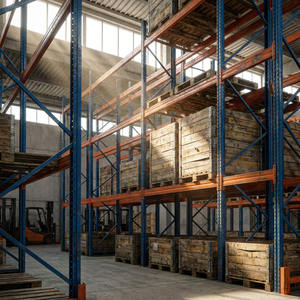
Heavy Duty Steel Warehouse Rack Industrial Pallet Storage Selective Rack System
Engineered for 100% direct pallet accessibility. Offers maximum adaptability for high-SKU logistics hubs, customizable beam levels, and heavy structural load capacities.
Certified rack architectures engineered for heavy unit loads, high volume throughput, and demanding operational environments.
Engineered for 100% direct pallet accessibility. Offers maximum adaptability for high-SKU logistics hubs, customizable beam levels, and heavy structural load capacities.
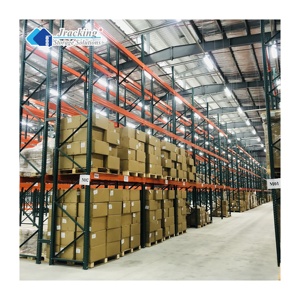
Industry-standard teardrop connection system featuring toolless beam adjustment, high-tensile steel uprights, and dynamic impact resistance for busy logistics centers.
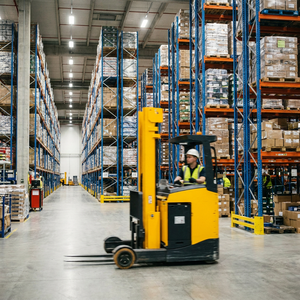
Vertical cubic volume optimization with integrated catwalks and multi-tier picking structures. Ideal for combined order fulfillment and bulk storage operations.
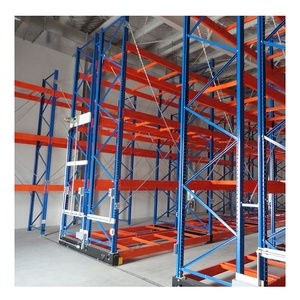
Motorized mobile bases moving along embedded rails. Eliminates fixed aisles to boost storage density by up to 85%, perfect for cold storage facilities.
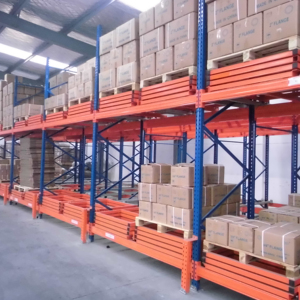
Nested cart system utilizing gravity for LIFO stock rotation. Accommodates 2 to 6 pallets deep while maintaining dedicated aisle access for forklifts.
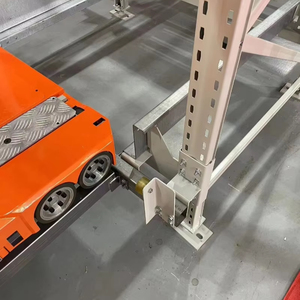
Autonomous 4-way robotic shuttles operating within high-density racking matrices. Seamlessly integrates with WMS/WCS for automated 24/7 dark warehouse operation.
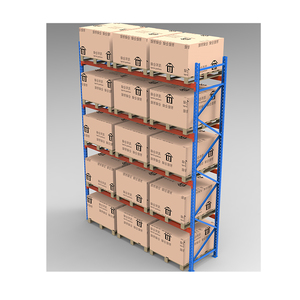
Heavy-duty structural steel racking engineered for harsh industrial environments, extreme weight requirements, and high-impact logistics loading zones.
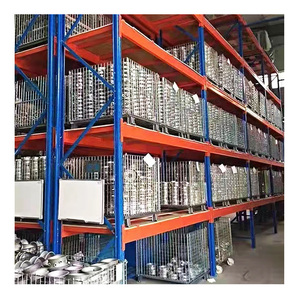
Very Narrow Aisle (VNA) system engineered to maximize vertical height and shrink aisle widths to 1.5m-1.8m, utilizing wire-guided turret trucks for top cubic efficiency.
Why leading industrial enterprises, 3PL providers, and cold-chain operators trust our structural rack manufacturing infrastructure.
As global supply chain logistics evolve under the dual pressures of industrial land scarcity and escalating operational costs, industrial real estate optimization has shifted from simple horizontal warehousing to sophisticated vertical cubic space utilization. Selecting top-tier pallet storage system manufacturers is no longer merely a procurement task for steel fabrication; it is a critical engineering decision that dictates long-term intra-logistics efficiency, structural safety, and capital expenditure ROI.
Global warehouse developments in highly seismic territories—such as the Pacific Rim "Ring of Fire" encompassing Chile, Japan, and the US West Coast—demand strict dynamic load-bearing capabilities. Modern racking designs must account for site-specific ground acceleration, soil elasticity classifications, and live load dynamic oscillations during seismic events.
Leading global suppliers utilize advanced 3D Finite Element Analysis (FEA) software to model frame stiffness, beam-to-column connector plastic hinge behavior, and baseplate anchor shear forces under extreme lateral loading. Compliance with international standards such as NCh2369, NCh433, ANSI MH16.1 (RMI), and FEM 10.2.02 ensures that fully loaded pallet rack systems absorb seismic kinetic energy without structural buckling or cataclysmic collapse.
Heavy-duty seismic baseplates featuring multi-anchor arrays redistribute localized floor slab shear forces, mitigating structural upright tearing.
Multi-tang connector hooks with automatic safety locks ensure connection integrity during dynamic vertical and horizontal load reversals.
Procurement teams are moving away from evaluating storage infrastructure purely on initial steel cost per ton. Strategic procurement methodologies focus on the total Cost-Per-Pallet Position (CPPP) over a 15-to-20-year operational lifecycle.
| Storage System Type | Selectivity Rate | Volume Utilization | Forklift / MHE Requirements | Ideal Procurement Scenario |
|---|---|---|---|---|
| Selective Pallet Racking | 100% Direct Access | 40% - 50% | Standard Counterbalance / Reach | High SKU variety, fast pick frequency, broad logistics hubs |
| Very Narrow Aisle (VNA) | 100% Direct Access | 65% - 75% | Turret Trucks / Articulated Forklifts | High-bay urban distribution centers with premium floor costs |
| Push-Back Cart Racking | LIFO (By Lane) | 70% - 80% | Standard Forklifts | Medium SKU density, batch manufacturing, cold storage |
| Motorized Mobile Racking | 100% Selective (On Demand) | 85% - 90% | Standard Reach Trucks | Deep freeze environments (-25°C) with extreme power costs |
| Four-Way Radio Shuttle (ASRS) | FIFO / LIFO Dynamic | 85% - 95% | Automated Shuttles + AGVs / AMRs | High-volume distribution, FMCG, automated dark warehouses |
As corporate ESG (Environmental, Social, and Governance) commitments become mandatory globally, leading storage manufacturers are transitioning to low-carbon structural steel production, utilizing recycled scrap raw materials refined via Electric Arc Furnace (EAF) technology.
Furthermore, in specialized industries such as aquaculture in Los Lagos, fresh produce packing in O'Higgins, or cold logistics in global maritime ports, standard powder coating is insufficient. Suppliers must provide advanced hot-dip galvanizing (HDG) or specialized epoxy powder coatings that resist high moisture condensation, corrosive saline air, and extreme sub-zero temperature thermal contractions without peeling or flaking.
The industrial storage industry is undergoing a digital and metallurgical evolution. Smart warehouse infrastructure is bridging the gap between passive structural steel frames and active digital asset management systems.
Modern rack columns are increasingly integrated with strain-gauge sensors and acoustic-emission monitors that alert facility management instantly to forklift collisions or localized structural micro-deflections beyond safety thresholds.
Four-way shuttle tracks feature laser positioning, barcode navigation grids, and wireless mesh networks, allowing fleet optimization algorithms to adjust pallet buffering dynamically based on ERP order dispatch schedules.
Advances in cold-roll forming allow manufacturers to utilize high-yield strength steel profiles (up to Q355B/Q460 or ASTM A1011 Grade 50) that reduce structural deadweight while increasing maximum allowable beam deflection resilience.
Universal beam connector clip matrices and multi-hole upright profiles facilitate rapid reconfiguration or vertical frame expansions without requiring structural cutting or on-site welding.
Expert guidance on engineering standards, structural safety, compliance regulations, and system selection.
Consult with our engineering team today for custom layout designs, site-specific seismic calculations, and direct factory quotation pricing for your warehouse development.
Inquire Now