Engineered Warehouse Storage Racking Systems
Explore our factory-direct OEM/ODM selective, teardrop, push-back, and intelligent radio shuttle racking systems built to international ISO, CE, and seismic safety standards.
Why Global Supply Chains Rely on Our OEM/ODM Racking
Direct factory manufacturing combining advanced FEA structural modeling, cold-rolled high-strength steel grades, and precision international compliance.
Full OEM/ODM Customization
We engineer customized rack upright profiles, box beam heights, connector hook configurations, and pitch adjustments (50mm, 75mm, 76.2mm teardrop) tailored precisely to your handling equipment and building envelope.
Seismic Engineering Compliance
Specifically calculated for high dynamic and seismic load zones (referencing NCh2369, NCh433, and RMI ANSI MH16.1), incorporating enlarged base plates, heavy-duty anchors, and high-ductility diagonal cross-bracing.
Q355B Cold-Rolled Steel Integrity
Manufactured using certified structural Q235B and Q355B high-tensile cold-rolled steel coils, ensuring superior yield strength, long-term fatigue resistance, and rigorous safety factors ($SF \ge 1.65$).
Severe Environment Coatings
Automated continuous powder-coating lines deliver epoxy-polyester coatings ($60\text{--}80\,\mu\text{m}$) or hot-dip galvanizing for extreme cold-storage ($ -30^\circ\text{C}$), high-humidity, and coastal chemical environments.
Knockdown Containerized Logistics
Engineered modular components maximize 40ft High-Cube container utilization, significantly lowering ocean freight costs per pallet position while avoiding shipping transport damage.
Turnkey Engineering & Support
From initial 2D/3D BIM CAD layouts and structural calculation books to on-site assembly guidance and post-occupancy rack inspection certifications, we support B2B distributors end-to-end.
Global Supply Chain Infrastructure & OEM/ODM Pallet Racking Architecture
As global supply chains expand across e-commerce logistics hubs, cold storage networks, and third-party logistics (3PL) fulfillment centers, the engineering demand on modern pallet warehouse racking systems has shifted from basic steel fabrication to high-precision structural engineering. Enterprise buyers, warehouse distributors, and regional racking importers face mounting pressures: maximizing vertical storage density, ensuring strict seismic survival compliance, reducing total cost per pallet position, and ensuring rapid deployment timelines.
As a leading OEM/ODM Pallet Warehouse Racking Exporter and Wholesaler, our manufacturing methodology integrates advanced metallurgy, automated cold-roll forming, continuous robotic welding, and automated powder electrostatic coating. We supply customizable industrial racking systems engineered to perform under extreme static loads, dynamic forklift impacts, and severe environmental stresses.
1. Selective Pallet Racking Architecture: Flexibility & Direct Access
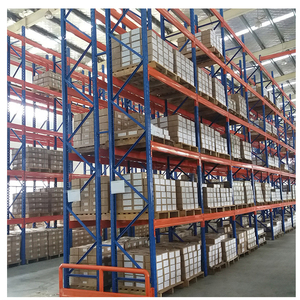
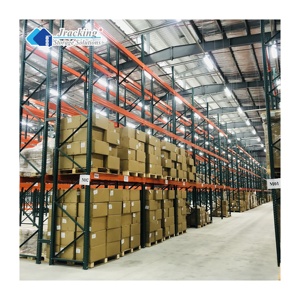
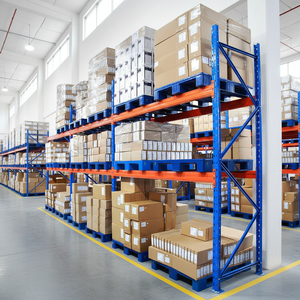
Selective pallet racking remains the cornerstone of modern warehouse distribution due to its 100% direct access to every SKU. Manufactured with cold-rolled upright frames and interlocked box beams, selective systems support variable aisle configurations, including standard wide-aisle (3.5m–4.5m) and Very Narrow Aisle (VNA) configurations operating up to 15 meters high.
- Upright Profiles: Roll-formed Omega ($\Omega$) section profiles with multi-ribbed bend geometries to maximize section modulus ($Z_x$) and moment of inertia ($I_x$).
- Box Beam Construction: Formed by nested C-channels continuously welded via robotic MIG processes, featuring 3-hook or 4-hook heavy-gauge end connectors with automatic safety locks.
- Load Capacities: Beam capacities engineered from $1,000\,\text{kg}$ to over $4,500\,\text{kg}$ per pair, respecting deflection limits of $L/180$ under maximum allowable load.
2. High-Density Push-Back & Radio Shuttle Systems: Maximizing Cube Utilization
When warehouse real estate is premium—such as in refrigerated cold stores or high-density port facilities—selective racking gives way to high-density semi-automated solutions:
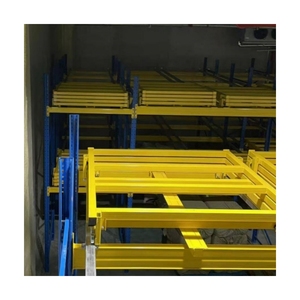
- Push-Back Pallet Racking: Operating on a Last-In, First-Out (LIFO) inventory principle, push-back systems utilize nested inclined carts riding on structural steel rails. As a new pallet is loaded, it gently pushes existing pallets back into the lane up to 6 pallets deep.
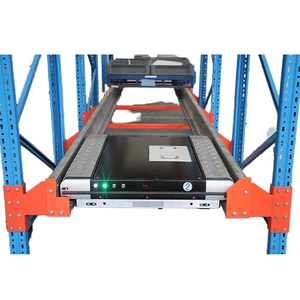
- Intelligent Radio Shuttle Racking: A semi-automated high-density system where self-powered battery shuttles navigate deep storage channels (up to 40+ pallets deep). Controlled via RF remotes or WMS interfaces, radio shuttle racking dramatically cuts forklift travel times, eliminates aisle space, and increases storage density by up to 80% compared to traditional selective racking.
Technical System Comparison: Selecting the Optimal Racking System
Selecting the correct structural configuration requires balancing SKU velocity, accessibility, floor space cost, and material handling equipment capabilities. Below is an engineering overview of our OEM/ODM racking portfolios:
| Racking System Type | Storage Density | SKU Accessibility | Inventory Principle | Standard Bay Load Capacity | Typical Applications |
|---|---|---|---|---|---|
| Selective Racking | Moderate (40–50%) | 100% Direct Access | FIFO / LIFO | Up to 25,000 kg / Frame | 3PL Logistics, Retail Distribution, FMCG |
| Teardrop Racking | Moderate (40–50%) | 100% Direct Access | FIFO / LIFO | Up to 20,000 kg / Frame | North American Warehouses, Hardware Wholesalers |
| Push-Back Racks | High (65–75%) | Lane-Selective | LIFO | Up to 1,500 kg / Pallet | Cold Storage, Food & Beverage, Bulk Batches |
| Radio Shuttle Racking | Ultra-High (80–90%) | Channel-Selective | FIFO / LIFO | Up to 2,000 kg / Pallet | Frozen Food, Pharmaceutical, Automated Logistics |
| Heavy Duty Shelving | Moderate (Hand-Pick) | 100% Manual Access | FIFO | Up to 1,000 kg / Shelf level | Spare Parts, E-Commerce Picking, Industrial Tools |
Seismic Engineering Compliance & Structural Safety Standards
Warehouse racking structures act as heavy unbraced or semi-braced steel towers holding hundreds of metric tons of dynamic mass. In seismically active regions worldwide—such as the Pacific Rim earthquake zones (Chile, Peru, West Coast USA, Japan, New Zealand)—a standard static racking design poses severe failure risks during dynamic ground acceleration.
Seismic Analysis & Structural Verification
Our engineering team performs site-specific dynamic response spectrum analysis and Finite Element Analysis (FEA) based on established international design codes, including ANSI MH16.1 (RMI), EN 15512, and regional Chilean building standards like NCh2369 & NCh433.
- Base Plate Anchor Shear & Uplift: Seismic motion induces high overturning moments ($M_o$) and uplift forces ($T_u$) on column base plates. We engineer enlarged heavy-duty forged steel footplates anchored using chemical or mechanical expansion anchors tested for cracked concrete.
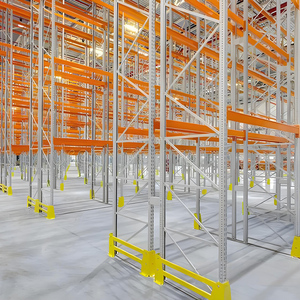
- Bracing Pattern Optimization: Standard K-bracing or X-bracing patterns on upright frames are reinforced with structural tubular diagonals to withstand cyclic lateral sway without premature local buckling.
- Beam-to-Column Connection Ductility: Hook connectors feature specific lock geometry to prevent beam dislodgement under violent vertical acceleration vectors while maintaining structural stiffness ($K_\theta$).
Proper structural engineering prevents dynamic rack collapse, protects warehouse personnel, preserves inventory value, and guarantees compliance with municipal building permits and commercial property insurance underwriting requirements.
Future Procurement Trends in Industrial Warehouse Racking (2025–2030)
As supply chain directors, industrial real estate developers, and procurement managers evaluate long-term capital expenditure (CapEx) in logistics infrastructure, several key macro trends are shaping the future of industrial racking procurement:
1. Transition Toward Semi-Automated & AGV-Integrated Racking
Rising labor costs and labor shortages globally are driving rapid conversion from conventional manual forklift racking to Automated Guided Vehicle (AGV), Autonomous Mobile Robot (AMR), and Automated Storage and Retrieval System (AS/RS) compatible racking. Racking manufacturing tolerances are tightening from standard industrial fractions to millimeter-level precision ($\pm 1.5\,\text{mm}$) to accommodate robotic optical sensors and automated shuttle guidance channels.
2. Cold Chain Infrastructure Expansion & Energy Efficiency
Global demand for temperature-controlled food logistics, bio-pharmaceuticals, and frozen goods is outstripping ambient warehouse growth. Because cooling a massive cubic envelope is energy-intensive, procurement trends heavily favor maximum cube utilization. High-density Radio Shuttle racking and Mobile Racking systems (where racking blocks slide on embedded floor tracks) will dominate cold chain capital investments.
3. Circular Steel Sourcing & Low-Carbon Manufacturing
Environmental, Social, and Governance (ESG) mandates are increasingly included in global tender requests. Enterprise buyers require racking manufacturers to provide Environmental Product Declarations (EPD), utilize electric arc furnace (EAF) recycled steel coils, and implement zero-VOC powder coating processes to meet Scope 3 carbon reduction targets.
4. Modular OEM Design & Rapid Reconfigurability
Fast-shifting e-commerce order profiles demand storage systems that can adapt quickly. Procurement managers are prioritizing modular teardrop and boltless selective designs that allow beam levels to be adjusted without specialized tools, enabling seamless integration of carton flow tracks, wire mesh decking, or pick-module platforms.
Frequently Asked Questions (FAQ)
Technical insights and commercial guidelines for global racking buyers, importers, and warehouse engineers.
Why is structural seismic design mandatory for warehouse pallet racking?
Industrial pallet racks store massive weight at elevated heights. During an earthquake, horizontal ground acceleration creates extreme shear and bending moments in the racking frames. Standard racks designed solely for static vertical loads can suffer column buckling or beam disconnection under seismic sway. Seismic design factors in ground peak acceleration (PGA), soil type, and building ductility to reinforce frames, base plates, and anchors according to standards such as NCh2369, NCh433, and RMI ANSI MH16.1.
What steel grades and surface finishes are used in your OEM/ODM manufacturing?
We primarily utilize high-tensile structural steel grades Q235B and Q355B (equivalent to ASTM A36 and ASTM A572 Grade 50). For surface protection, we offer continuous electrostatic epoxy-polyester powder coating (60–80 microns) for standard dry environments, and hot-dip galvanizing (EN ISO 1461) for high humidity, outdoor storage, or aggressive sub-zero cold room environments.
How does a Radio Shuttle racking system compare to standard Drive-In racking?
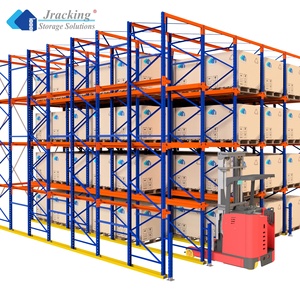
While both systems offer high-density storage, Drive-In racking requires forklifts to physically drive inside the narrow racking channels, increasing the risk of frame impact damage and slowing down retrieval times. Radio Shuttle racking uses an autonomous battery shuttle to transport pallets inside the lanes. This eliminates forklift entry into channels, increases loading speed by up to 50%, supports both FIFO and LIFO modes, and significantly lowers structural maintenance costs caused by collision damage.
What technical data is required to request an OEM/ODM racking layout and quotation?
To provide an accurate CAD design and engineering quotation, we require: (1) Warehouse building drawings including floor slab dimensions, clear height, column grids, and door locations; (2) Pallet specifications (Width x Depth x Height including cargo, and gross weight per pallet); (3) Material handling equipment data (forklift model, maximum lift height, and minimum aisle turning radius); (4) Operating environmental conditions (ambient, cold storage temperature, or seismic location zone).
What is your typical production lead time and international ocean container packing strategy?
Standard OEM manufacturing lead time is 20 to 35 days depending on total metric tonnage and custom profile requirements. All racking components are bundled using protective steel strapping, corner edge guards, and plastic stretch film. Uprights and beams are systematically nested to maximize 40ft High-Cube container loading space while preventing freight damage during ocean transport.
Accelerate Your Warehouse Capacity & Request a Custom Engineering Plan
Partner with a premier OEM/ODM pallet racking exporter. Contact our structural engineering team today for technical consultation, complimentary 2D/3D layout designs, and competitive wholesale factory pricing.