Executive Whitepaper: Industrial Pallet Racking Architecture & Global OEM Supply Chain Dynamics
In modern industrial logistics, storage systems are no longer passive steel frame assemblies; they are dynamic structural assets engineered to directly influence inventory velocity, operational safety, and floor-to-ceiling volumetric efficiency. As global supply chain networks face unprecedented challenges—ranging from land cost inflation to stringent workplace safety mandates—selecting the right Custom OEM Warehouse Pallet Storage Racks Exporter & Wholesaler is a decisive strategic parameter for logistics directors, warehouse developers, and procurement executives.
This technical whitepaper provides an exhaustive analysis of structural steel selection, finite element analysis (FEA) modeling, seismic design standards, surface preservation technologies, and emerging procurement shifts. By bridging the gap between raw structural engineering and operational utility, we outline how tailor-made rack manufacturing unlocks measurable information gain, operational throughput, and total cost of ownership (TCO) optimization.
Structural Steel Metallurgy: Q235B vs. Q355B Micro-Alloyed Grades
Our OEM manufacturing processes exclusively utilize high-yield, cold-rolled structural steel coils certified under EN 10025 and ASTM standards. Transitioning from standard Q235B to micro-alloyed Q355B cold-formed profiles increases yield strength from 235 MPa to 355 MPa. This structural advantage permits a 18% reduction in deadweight steel mass while increasing ultimate vertical load capacity, reducing shipping container freight charges, and ensuring structural compliance across high-seismic zones globally.
Engineering Core Capabilities & Manufacturing Excellence
As a vertically integrated OEM exporter, our production facilities utilize advanced automated cold-roll forming lines, robotic laser cutting cells, and continuous electrostatic powder coating tunnels. Every racking profile—from roll-formed teardrop uprights to heavy-duty structural C-channels—undergoes strict Quality Assurance (QA) protocols aligned with ISO 9001:2015 standards.
FEA Structural Simulation
Every custom beam connection and upright profile is modeled via 3D Finite Element Analysis (FEA) software. We simulate dynamic buckling, torsion, uneven pallet load distribution, and forklift impact vectors prior to physical fabrication.
Seismic Zone Compliance
Custom rack designs adhere strictly to site-specific seismic ground acceleration parameters outlined in Chilean NCh2369 / NCh433, US RMI (Specification for the Design, Testing and Utilization of Industrial Steel Storage Racks), and European EN 15512 codes.
Duplex Surface Protection
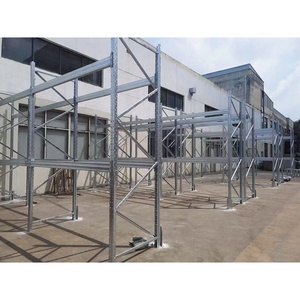
Offering thermosetting epoxy-polyester powder coating (60–80 microns thick) for temperature-controlled ambient stores, and continuous hot-dip galvanizing (ASTM A123, >85 microns) for severe humidity, coastal, and sub-zero cold-storage (-30°C) facilities.
Racking Architectural Performance Matrix
Choosing the ideal storage system requires balancing SKU selectivity against storage density. The comparative matrix below outlines structural metrics across major warehouse racking typologies manufactured in our OEM facilities:
| Racking System Type | Pallet Selectivity | Volumetric Floor Space Utilization | Max Load Capacity per Level | Forklift / Handling Equipment Requirement | Ideal Industry Application |
|---|---|---|---|---|---|
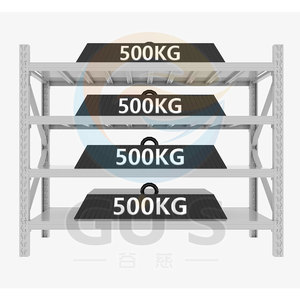
| Selective Pallet Racking | 100% Direct Access | 40% – 50% Floor Utilization | Up to 4,500 kg | Standard Counterbalance / Reach Trucks | High-SKU 3PL Distribution, FMCG, Retail |
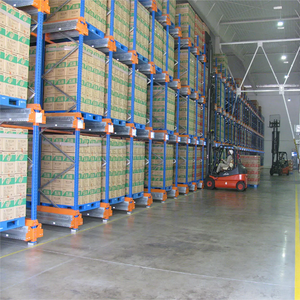
| Radio Pallet Shuttle | Filtered (FIFO / LIFO) | 80% – 90% Floor Utilization | Up to 1,500 kg / pallet | Semi-Automated Shuttle + Standard Forklift | Cold Storage, Food & Beverage, Beverage Bottling |
| Drive-In / Drive-Thru Racking | LIFO (Drive-In) / FIFO (Thru) | 65% – 75% Floor Utilization | Up to 1,500 kg / position | Specialized Narrow-Upright Reach Trucks | Homogeneous Seasonal Inventory, Bulk Raw Materials |
| Very Narrow Aisle (VNA) | 100% Direct Access | 80% – 85% Vertical Height Utilization | Up to 3,000 kg | VNA Turret Trucks / Wire-Guided Automated Trucks | High-Bay E-Commerce Hubs, Pharmaceuticals |
| Hot-Dip Galvanized Outdoor | 100% Direct Access | Flexible Outdoor Footprint | Up to 5,000 kg | Heavy-Duty All-Terrain Counterbalance | Building Materials, Chemical Drums, Yard Storage |
Global Procurement Trends & Next-Gen Storage Innovations
The global industrial warehouse racking market is experiencing a profound transition driven by automation, sustainability compliance, and resilient regional supply chains. B2B procurement leaders must account for the following macro trends when specifying custom OEM racking systems:
1. Integration of Automated Storage & Semi-Automated Subsystems (AS/RS & Shuttles)
Labor cost spikes and urban real-estate scarcity have accelerated the adoption of high-density semi-automated solutions. Traditional static racking is rapidly giving way to Radio Shuttle Racking and fully automated AS/RS (Automated Storage and Retrieval Systems). OEM rack manufacturers must maintain precise fabrication tolerances (within ±0.5mm per beam span) to ensure smooth sensor tracking, rail alignment, and automated shuttle transit without mechanical jam risk.
2. Transition Toward Green Steel & Low-Carbon Supply Chains (ESG Compliance)
Enterprise buyers across North America, Europe, and Asia-Pacific now enforce strict Environmental, Social, and Governance (ESG) guidelines. Our OEM manufacturing processes are optimizing energy inputs, reducing powder coat VOC emissions, and sourcing structural steel from mills utilizing Electric Arc Furnaces (EAF) powered by renewable energy grids. This yields low-embodied-carbon warehouse racking that contributes directly to LEED and BREEAM building certifications.
3. Seismic Safety Mandates & Structural Life-Cycle Auditing
Global regulatory bodies are intensifying enforcement of workplace safety standards (such as OSHA, EN 15635, and Chilean Decree 594). Racking buyers no longer accept off-the-shelf catalog solutions without site-specific structural verification. Modern procurement strategies require certified engineering dossiers containing seismic calculation reports, soil anchor pull-out test data, and pre-installed structural impact indicators.
4. Modular OEM Customization for Hybrid Fulfillment Centers
Omnichannel retail demands warehouses to handle both bulk pallet storage and high-speed piece-picking simultaneously. Advanced OEM designs integrate multi-tier pick modules, carton flow tracks, and wire mesh decking directly into heavy-duty selective rack frameworks, maximizing multi-level cubic volume without increasing physical building footprint.
Why Partner with Our Global OEM Engineering Network?
As a premier manufacturer and exporter, our business model is built around solving complex spatial, structural, and budgetary challenges for enterprise clients worldwide. By maintaining complete control over raw steel sourcing, cold-roll profile engineering, and international freight packaging, we provide significant structural advantages over standard regional distributors:
End-to-End OEM/ODM Customization
From custom beam profile gauge thicknesses (1.5mm to 3.0mm) to proprietary upright pitch punches, we engineer solutions to match your exact forklift dimensions, pallet formats (GMA, EURO, Australian Standard), and building columns.
Container Freight Optimization
Our experienced export logistics team optimizes nesting profiles during beam bundling and upright stack packaging. This increases container volumetric efficiency by up to 25%, drastically reducing per-unit ocean freight transport costs.
Rigorous Quality Assurance & Traceability
Full raw material mill test certificates (MTC) supplied with every batch. Ultrasonic weld testing, salt spray corrosion testing, and load-to-destruction sample testing ensure zero-defect compliance prior to export dispatch.
Frequently Asked Questions (FAQ)
Answers to common structural, logistics, and engineering queries raised by global procurement managers and warehouse facility engineers.