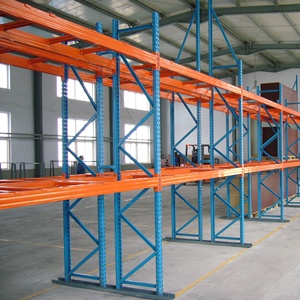
Factory-Direct Heavy Storage OEM
High-Performance Industrial Racking Portfolio
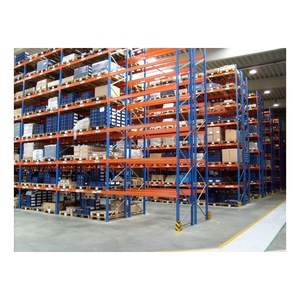
Engineered to international FEM, RMI, and Chilean NCh2369 seismic standards. Fully customizable roll-formed and structural steel configurations manufactured for high-bay logistics centers and cold chains.
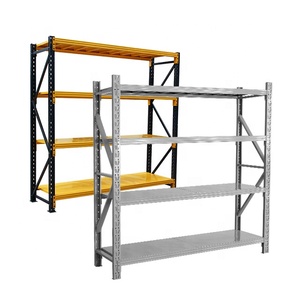
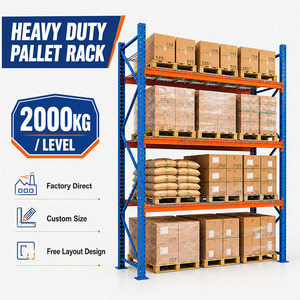
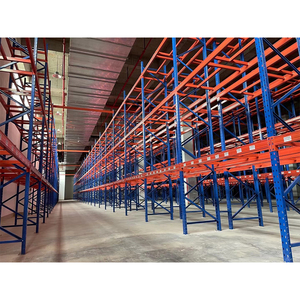
Whitepaper & OEM Procurement Guide
The Engineering Physics of Structural Industrial Storage Racking
Industrial pallet racking is not merely static steel shelving; it is an engineered dynamic load-bearing structure subjected to severe static dead loads, live forklift impacts, and unpredictable seismic lateral forces. As a premier custom OEM factory and global exporter (ChileShelving Industrial Systems SpA and global logistics infrastructure), our structural engineering paradigm focuses on structural yield optimization, cold-formed section stability, and dynamic force dissipation.
Standard off-the-shelf industrial racks often suffer from systemic design deficiencies when subjected to high-bay storage environments exceeding 12 meters in height. By utilizing high-tensile hot-rolled and cold-rolled structural steel grades—specifically Q235B, Q355B, and SS400—our factory custom-engineers section moduli ($Z_x, Z_y$) to prevent torsional buckling under max payload scenarios.
Structural Integrity Metrics
- Steel Yield Strength: Q355B (Minimum 355 MPa Tensile Yield for Heavy Uprights).
- Beam Deflection Limit: Engineered precisely to $\le L/200$ under full static dynamic loading.
- Safety Factor: 1.55 Structural Overload Coefficient per FEM 10.2.02 and RMI standards.
- Finish Coating: Electrostatic Epoxy Powder (80-120 μm) or Hot-Dip Galvanizing (ISO 1461).
Factory Production Infrastructure
Advanced Manufacturing & Surface Finishing Technology
From raw cold-rolled steel coils to precision-punched tear-drop and omega upright profiles, our automated OEM manufacturing line maintains strict dimensional tolerances within ±0.5mm.
Continuous Automated Roll-Forming
Our 22-pass CNC continuous cold roll-forming lines shape structural profiles with uniform wall thickness and zero internal residual strain. Punching machines punch 50mm and 75mm pitch pattern slots for total beam height adjustability.
Robotic MIG/TIG Welding
Beam connector claw plates are welded to box beams using 6-axis Panasonic robotic welding stations. Every joint undergoes non-destructive ultrasonic testing to guarantee zero weld penetration defects or micro-cracking.
Hot-Dip Galvanizing & Powder Coating
For sub-zero food cold storage (-25°C) and corrosive mining environments (Antofagasta, coastal ports), we supply hot-dip galvanized steel panels (ISO 1461, >65μm zinc thickness) and chemical-resistant thermosetting epoxy coatings.
Procurement Decision Framework
Industrial Storage System Engineering Comparison
Selecting the optimal OEM racking geometry depends on SKU diversity, warehouse volume utilization factor (VUF), forklift turn-aisle dimensions, and overall total cost of ownership (TCO).
| Storage System Type | Volume Utilization (VUF) | Pallet Selectivity | Handling Equipment Required | Ideal Industry Application | Cost per Pallet Position |
|---|---|---|---|---|---|
| Selective Pallet Racking | 40% - 50% | 100% Direct Access | Standard Counterbalance / Reach Truck | FMCG, 3PL Logistics, Retail Distribution | Economical ($$) |
| Drive-In / Drive-Through | 65% - 75% | LIFO / FIFO Bulk Access | Counterbalance Forklift | Cold Storage, Seasonal Agro-Export, Beverage | Moderate ($$$) |
| Radio Shuttle Automation | 80% - 90% | Deep-Lane FIFO/LIFO | Semi-Automated Shuttle Cart + Forklift | High-Density Frozen Food, Pharmaceuticals | Advanced ($$$$) |
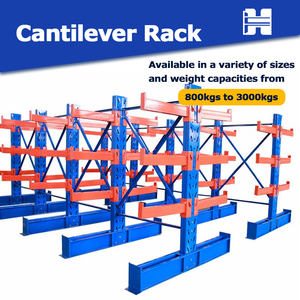
| Cantilever Racks | 50% - 60% | 100% Long Goods | Side Loader / Overhead Crane | Steel Pipe, Lumber, Plastic Extrusions, Mining | Custom Heavy ($$$) |
| Very Narrow Aisle (VNA) | 70% - 85% | 100% Direct Access | VNA Turret Truck / Wire Guided | High-Bay E-Commerce Hubs, Spare Parts | Capital Intensive ($$$$) |
Industry Insights
Future Trends in Global Industrial Storage Procurement
The industrial storage equipment sector is undergoing structural technological transformations driven by warehouse automation, carbon neutral mandates, and supply chain resiliency demands.
1. Integration of ASRS & Semi-Automated Radio Shuttles
Traditional static pallet shelving is rapidly giving way to high-density semi-automated radio shuttle racking and AS/RS (Automated Storage and Retrieval Systems). By replacing wide fork-truck travel aisles with automated shuttle channels, logistics operators double their pallet storage capacity within the same footprint. Our OEM factory designs shuttle rails with micro-tolerance alignments ($\le 1.0\text{mm}$ deflection) to guarantee smooth sensor-guided shuttle transit.
2. Cold-Chain Energy Optimization
Refrigerated warehouse operating costs are dominated by electrical power consumption. Every cubic meter of unutilized cold room volume represents recurring financial loss. High-density push-back, pallet-flow, and mobile automated racking minimize refrigerated air space loss, lowering cooling energy consumption by up to 35% while increasing pallet holding capacity.
3. Modular OEM Customization & Export Packaging
Global B2B buyers now demand knock-down modular frame designs that optimize ocean container loading density. Our factory utilizes engineered nesting packaging techniques that reduce 40ft HQ freight volume by 25%, drastically lowering transoceanic freight costs while protecting powder-coated surfaces from sea salt degradation.
4. Rigorous Regulatory Safety Compliance
International regulatory oversight (such as Chilean OSHA Decree 594, Law 16.744, and European EN 15635) mandates annual expert rack structural safety audits. Modern procurement requires factory suppliers to deliver complete finite element analysis (FEA) engineering dossiers, certified material test certificates (MTC per EN 10204 3.1), and comprehensive installation structural guidelines.
Why Choose Our OEM Factory
Enterprise Advantages of Direct Factory Sourcing
Partnering directly with an established OEM manufacturing facility eliminates intermediary markups while providing structural engineering flexibility tailored to your exact warehouse layout.
Custom OEM & ODM Capability
We roll-form proprietary hole patterns, structural beam connectors, column profile depths (80mm to 140mm), and custom steel gauge thicknesses (1.5mm to 3.0mm) to match your exact dynamic load specifications.
Complete Safety Ecosystem
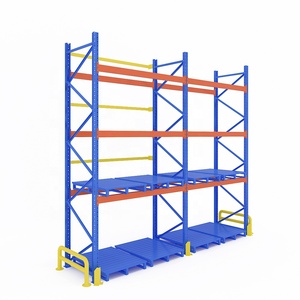
In addition to heavy uprights and beams, we manufacture integrated protection accessories: column guards, end-of-aisle heavy crash barriers, anti-collapse wire mesh decking, and steel back stoppers.
Global Export Footprint
With established supply chains servicing South America (Santiago, Antofagasta, Valparaíso), North America, Europe, and Australia, we manage end-to-end logistics, export customs clearance, and on-site engineering guidance.
Frequently Asked Questions
OEM Racking Procurement & Technical FAQ
In-depth technical answers for structural engineers, facility logistics managers, and global procurement officers.
How does raw steel grade selection (Q235B vs. Q355B) impact rack load capacity and cost?
Steel grade selection directly dictates the structural cross-sectional thickness required to achieve target load capacities. Q235B steel has a minimum yield strength of $235 \text{ MPa}$, making it an economical choice for low-to-medium height selective rack uprights and standard light-duty shelf beams. Q355B steel (yielding $\ge 355 \text{ MPa}$) offers roughly 50% greater yield strength. Utilizing Q355B allows our engineers to reduce profile wall thickness while maintaining identical or superior beam load limits (up to 4,500 kg per level), effectively decreasing shipping dead weight and lowering raw material consumption for high-bay applications exceeding 10 meters.
Are pallet racking systems required to be engineered for site-specific seismic conditions?
Yes. In seismically active zones—such as Chile (under NCh2369 for industrial structures and NCh433 for general building codes), Japan, New Zealand, and western North America—racking cannot be installed using static non-seismic catalogue designs. Seismic engineering mandates site-specific calculations factoring in ground acceleration factors ($A_0$), soil seismic response category, and structural ductility. Seismic-ready racking incorporates oversized footplates with multi-anchor hole arrays, upgraded diagonal frame bracing geometry, dynamic flexural beam connectors, and reinforced anchor bolt torque specs to prevent structural racking collapse during severe ground tremors.
What is the standard allowable beam deflection tolerance under maximum payload?
Per international FEM 10.2.02 and RMI (Rack Manufacturers Institute) standards, the maximum vertical elastic deflection ($\delta$) of a structural load beam under full uniformly distributed load (UDL) must not exceed 1/200th of the clear span length ($\delta \le L/200$). For example, a 2,700mm beam under 3,000 kg total payload can deflect a maximum of 13.5mm at mid-span. Once the load is removed, the beam must return to zero permanent deformation. Our factory subjects every beam design to destructive physical load testing to verify compliance with this elastic limit.
Which racking finish is recommended for sub-zero food cold storage vs. standard ambient warehouses?
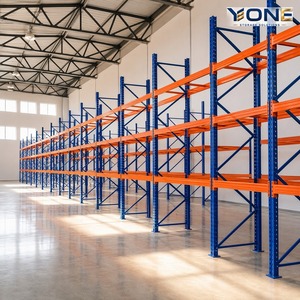
For standard ambient warehouses, electrostatic epoxy powder coating (thickness 80-120 microns) cured at 180°C to 200°C provides superior scratch resistance, vibrant color-coded load identification (e.g., Orange RAL 2004 beams, Blue RAL 5015 uprights), and cost efficiency. However, in sub-zero cold rooms (-25°C) or high-humidity coastal facilities where condensation causes rapid steel oxidation, Hot-Dip Galvanizing (HDG per ISO 1461) is mandatory. HDG coats all internal and external surfaces with a metallurgical zinc-iron alloy layer (>65 microns thick), ensuring 25+ years of maintenance-free rust resistance.
What lead time is typically required for custom factory OEM racking production and export container shipment?
Standard OEM manufacturing turnaround for a typical 5 to 10 container order (approx. 200 to 400 metric tons) is 20 to 25 calendar days from CAD structural sign-off and deposit confirmation. Ocean transit times vary by destination port (e.g., 25-30 days to Valparaíso/San Antonio, Chile; 18-22 days to US West Coast ports; 28-35 days to European hubs). Our logistics division coordinates container loading efficiency, ensuring components are bundled in erection order to speed up job-site unloading.
How often should installed warehouse pallet racks be professionally inspected?
Best international practice (EN 15635 standards and regional safety regulations) dictates that warehouse management conduct: (1) Weekly visual checks by internal safety officers to detect obvious forklift impact damage; (2) Documented formal annual inspections (every 12 months) by certified third-party rack inspection experts; and (3) Immediate post-event inspections following significant earthquake tremors or major forklift collisions. Damaged columns or dislodged safety pins must be categorized according to Green, Amber, and Red safety risk zones to determine if immediate unloading or structural column replacement is required.
Factory-Direct OEM Sourcing
Request a Custom Engineering Design & OEM Quotation
Submit your warehouse floor layout, building clear height, pallet dimensions ($W \times D \times H$), and unit load requirements. Our structural engineers will generate 2D/3D CAD layouts and factory-direct price estimates within 24 hours.