Heavy-Duty Industrial Pallet Racking Solutions
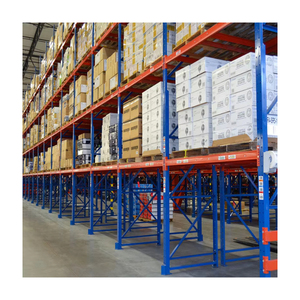
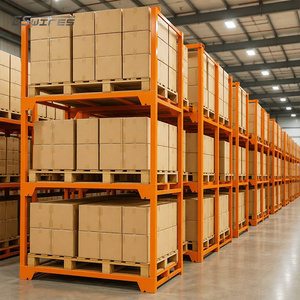
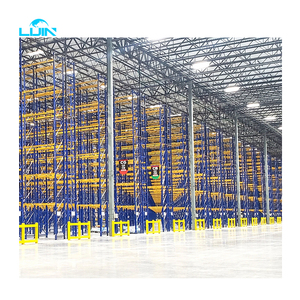
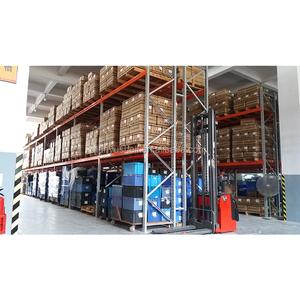
Precision-engineered cold-rolled steel pallet racks optimized for high-density logistics, seismic safety, and maximum vertical space utilization.
Why Engineering-Led Procurement Defines Safe Warehousing
Modern logistics demands more than simple steel beams. We deliver scientifically engineered pallet racking systems designed to absorb seismic stress, maximize volumetric cube efficiency, and maintain non-yielding safety under peak static and dynamic loads.
Certified CE & FEM Compliance
Our structural designs strictly adhere to European FEM 10.2.02, EN 15512, and American RMI (Rack Manufacturers Institute) standards. Every column profile and beam connector undergoes comprehensive finite element analysis (FEA) to ensure zero plastic deformation under maximum rated payloads.
Seismic-Ready Structural Engineering
Specifically engineered for high seismic risk operations (referencing NCh2369, NCh433, and Eurocode 8 criteria), our frame bracing configurations, enlarged base plates, and heavy-duty floor anchors are calculated based on site-specific dynamic ground acceleration and soil spectra.
Q355B Metallurgical Superiority
We utilize certified high-tensile cold-rolled steel (Q355B grade equivalent to SS50/S355) boasting yield strengths exceeding 355 MPa. Superior coil thickness uniformity prevents micro-fracturing during continuous profile roll-forming, delivering unmatched longevity in ambient and sub-zero cold stores.
Automated Epoxy Powder Coating
Components undergo an 8-stage pre-treatment wash including zinc phosphating, followed by electrostatic thermosetting epoxy-polyester powder coating (80–100 μm thickness). Tested to 500+ hours of continuous salt spray (ASTM B117), guaranteeing exceptional resistance against corrosion and abrasion.
Industrial Storage Racking Systems Architecture
Evaluating high-density structural configurations based on volumetric efficiency, SKU selectivity, and operational throughput speeds.
| Racking System Type | Storage Density | SKU Selectivity | Fulfillment Velocity | Ideal Industry Application | Max Unit Load / Bay |
|---|---|---|---|---|---|
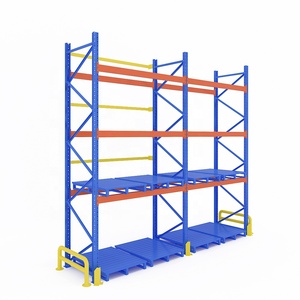
| Selective Pallet Racking | Standard (40-50%) | 100% Direct Access | High Turnover (FIFO) | General FMCG, 3PL Warehousing, E-commerce hubs | Up to 24,000 kg |
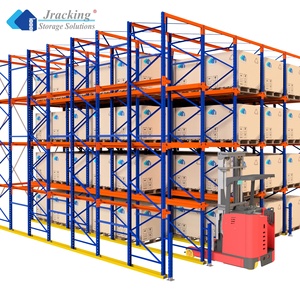
| Drive-In / Drive-Through | High (75-85%) | Low (LIFO / FIFO) | Moderate Batch Handling | Cold Storage, Seasonal Stock, Uniform Bulk Goods | Up to 15,000 kg |
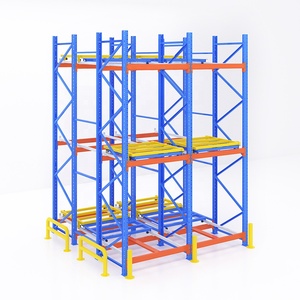
| Push Back Pallet Racking | High (65-75%) | Medium (2-6 Pallets Deep) | Fast Pallet Loading | Cold Chain Logistics, Food & Beverage Distribution | Up to 18,000 kg |
| Radio Shuttle Automation | Ultra-High (85-90%) | Semi-Automated (Programmed) | Exceptional Throughput | High-Volume Distribution, Pharmaceutical Freezers | Up to 30,000 kg |
| Nestainer & Portable Frames | Flexible Bulk Stacking | Block Stacking Access | Dynamic Modular Flow | Bulk Chemical Drums, Seasonal Agricultural Goods | Up to 2,000 kg / Unit |
Global Warehouse Racking Industry Development & Market Trends (2025–2030)
The global industrial warehouse racking market is undergoing a seismic transformation driven by the aggressive surge in cross-border e-commerce, automated fulfillment infrastructure, and hyper-dense urbanization. As industrial land values appreciate exponentially, supply chain executives are forced to maximize vertical building envelopes rather than expanding physical footprints. This structural pivot has repositioned pallet racking from passive steel shelving into high-precision, load-bearing infrastructure designed to integrate seamlessly with Autonomous Mobile Robots (AMRs), Very Narrow Aisle (VNA) turret trucks, and automated storage and retrieval systems (ASRS).
Furthermore, stringent workplace safety regulations enforced by global bodies—including OSHA in the United States, EU Directive 2009/104/EC, and regional seismic codes—have drastically raised the bar for procurement compliance. Industrial buyers are transitioning away from uncertified commodity steel fabricators toward verified exporters capable of supplying full metallurgical mill test reports, CE certification compliance dossiers, and site-specific structural calculation certificates.
Future Procurement Trends in Heavy-Duty Industrial Pallet Racks
Modern enterprise procurement teams are adopting holistic Total Cost of Ownership (TCO) models when evaluating industrial storage systems. The following macro-trends reflect the next decade of warehouse storage procurement:
- Automated Guided Vehicle (AGV) & AMR Integration: Modern structural selective racking is engineered with tighter manufacturing tolerances (within ±0.5mm profile straightness) to ensure guided robotic forks can perform high-speed insertions without structural clipping.
- Cold Chain Energy Footprint Optimization: Refrigerated and deep-freeze logistics (-25°C to -30°C) represent some of the most expensive operating cubes in global supply chains. High-density dynamic systems—such as Push Back, Pallet Flow, and Radio Shuttle systems—are rapidly replacing standard selective racks to compress thermal mass and reduce cooling energy overheads per pallet position by up to 40%.
- Structural IoT Health & Impact Monitoring: Enterprise logistics hubs are deploying dynamic strain gauges and piezoelectric sensors along critical upright columns. These real-time structural health monitors alert HSE (Health, Safety, and Environment) managers to micro-deflections and material fatigue caused by forklift strikes.
- Low-Carbon Green Steel & Sustainable Finishes: Environmental, Social, and Governance (ESG) mandates are driving demand for structural steel produced via Electric Arc Furnaces (EAF) powered by renewable energy, paired with VOC-free, heavy-metal-free thermosetting powder coatings.
Technical Deep-Dive: Material Integrity, Manufacturing & Seismic Design
Structural reliability in high-bay pallet racking is governed by the principles of cold-formed steel structural design. A failure in an industrial rack bay under a 20-ton static load can initiate catastrophic progressive collapse, jeopardizing human life and causing millions in inventory destruction.
Upright Column Geometry & Stiffness Profiles
The structural load capacity of an upright frame depends heavily on its cross-sectional geometry, ribbing, and moment of inertia. Our engineering team utilizes multi-flange upright profiles featuring up to 13 distinct cold-rolled bends. This complex cross-section drastically increases the column's resistance to torsional-flexural buckling under axial load forces.
Furthermore, teardrop and diamond-punched beam connector slots are precision-punched via CNC indexing presses prior to roll-forming. This maintains exact pitch accuracy (50mm, 75mm, or 76.2mm pitch configurations), allowing rigid, self-locking beam-to-column connection hooks with minimal joint rotation slack.
Beam Connector Locking Mechanics & Safety Clips
Box beams and step beams are fabricated by seam-welding two C-section profiles together, creating a closed structural beam with superior torsional rigidity. Heavy-duty 3, 4, or 5-hook structural connectors are robotically welded to beam ends using continuous Metal Active Gas (MAG) processes. Each connector is fitted with an automatic spring-loaded steel safety pin that prevents accidental beam dislodgement caused by upward forklift driver errors.
Comprehensive Procurement Guide & Quality Inspection Checklist
When sourcing industrial pallet racks from overseas manufacturers, procurement managers must establish rigorous Quality Assurance (QA) and Quality Control (QC) protocols prior to dispatch:
- Steel Material Traceability: Insist on EN 10204 3.1 Mill Test Certificates verifying yield strength (ReH), tensile strength (Rm), and elongation percentages for all steel coils.
- Weld Integrity & NDT Testing: Beam connector welds must be visually inspected and randomly subjected to Ultrasonic Testing (UT) or Magnetic Particle Inspection (MPI) to detect sub-surface porosity.
- Coating Adhesion & Thickness: Dry film thickness (DFT) must be verified across upright faces, inner channels, and welds using magnetic gauges (minimum 80 μm). Cross-hatch tape adhesion tests (ISO 2409) guarantee powder bonding strength.
- Anchor Bolt Shear & Pull-Out Calculations: Base plates must be secured with mechanical wedge anchors or chemical resin anchors sized for floor slab compressive strength (minimum C20/25 concrete).
Frequently Asked Questions
Expert technical answers addressing regulatory compliance, seismic engineering, load limits, and international shipping parameters.
Why is CE Certification essential for importing industrial pallet racks?
What is the difference between Q235B steel and high-tensile Q355B steel in pallet racking?
How do seismic design criteria affect industrial rack engineering?
What beam deflection limits should be specified for heavy-duty storage?
How are industrial pallet racks packaged for international ocean export?
What maintenance and inspection schedules are required post-installation?
Engineered Warehouse Solutions tailored to your operational KPIs
Work directly with our senior structural engineering team. Send us your CAD floor plans, pallet dimensions, clear height constraints, and load requirements for a complimentary CAD layout and certified load calculation quote.
Contact Us